
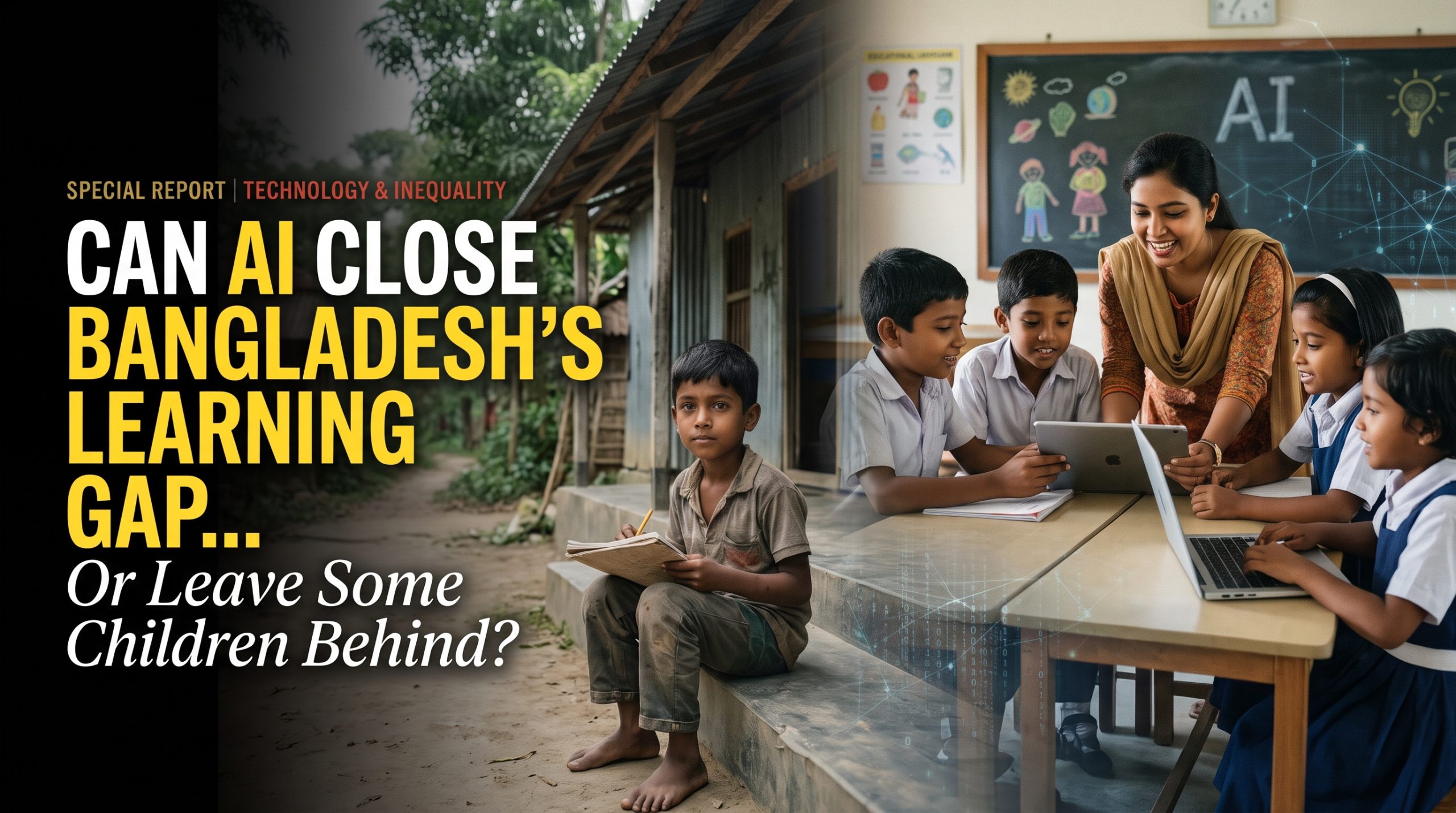
Artificial intelligence (AI) is reshaping the way in which information is accessed, learned and taught. Teachers can use AI tools to create quizzes for students and to explain difficult topics in the lessons. But for all pupils and teachers, that advantage of technology is not equal. In Bangladesh, the problem is not just about bringing AI into the classrooms, but also giving children a good education in the first place. According to the Multiple Indicator Cluster Surveys (MICS) 2025 conducted by UNICEF in Bangladesh, the statistical figures for children aged 7-14 show that the proportion of children who can read with foundational skills is 50.2% and the proportion of children who have foundational numeracy skills is 39.2%. Many children have problems with basic learning during their school years, as these figures indicate.
Although AI might help commemorate these challenges, restricted access to technology might further push disadvantaged students out of the picture.
The value of education is important in equipping children with knowledge and skills to engage in society and carve out their future. Students can have trouble understanding lower-level concepts which can make it hard to keep with the concepts in the higher level. AI can provide further explanations, practice exercises and learning material. It can also be used as a support to design lessons at various learning levels. But in AI-generated information, there might be false information about that child or information that is not appropriate for them or that they do not and cannot understand. Relying on without proper supervision can establish new learning issues rather than resolving existing issues.
The maintenance of school attendance, especially for students in low-income families, rural schools and under resourceful schools, can be the most challenging. Others don’t have their own personal devices, access to the internet, or a noiseless study area. For teachers who are assigned to large classes, they may also not have enough time to work on individual students. With children already having difficulty reading and/or doing math, there is a need to provide them support not just access to new technology.
However, UNICEF’s MICS 2025 revealed that foundational reading and numeracy are still significant issues among children in Bangladesh. The figures below show the challenge in learning that AI may be able to address but not its impact.Technically, providing Internet access is not enough to significantly improve the teaching-learning process because it is necessary to have suitable instruments, cost-effective data, and knowledge of using AI effectively. This happens because of several factors including imbalance in income of the household, lack of technical infrastructure, teacher training, school’s resources, etc. Schools also require guidance in relation to student privacy, data protection, and use of AI in an accurate and responsible manner. AI could exacerbate existing disparities if these precautions were not put in place.
Left unfilled, learning gaps have the potential to let many children continue to move through school without acquiring important skills. This may impact on their future education and employment prospects. Access to digital tools is likely to provide additional benefits to learners with greater access, driving the inequality gap between privileged and disadvantaged learners even wider.
Bangladesh should avail inexpensive digital infrastructure; practical AI training for teachers should be carried out and clear guidelines should be provided for responsible use of AI in classrooms. With lesson planning, assessment and differentiated learning materials. Schools will also have to make sure that children are not excluded due to a lack of a personal device. Reflective Teens’ innovation of ChalkPad AI is a relevant example. Its HundrED innovation profile details a tool to be used to develop lesson plans, quizzes and class notes in alignment with the curriculum, and reports on a pilot with over 100 teachers at Maheshkhali. The data is that of profiles and should not be construed as independently verified impact data.
While AI can aid educators and enhance education, it will not resolve the inequities of the education system. Bangladesh needs to bring together all the three elements: use of AI responsibly, teachers’ development, and equitable access and evidence-based teaching. AI doesn’t just need to be integrated into classrooms; it must ensure that every child has a real opportunity to learn.
Reference:
UNICEF Bangladesh. (2026). Information on the situation of children in Bangladesh.
https://www.unicef.org/bangladesh/en/data-situation-children-bangladesh
HundrED Foundation. (2026). ChalkPad AI.
https://foundation.hundred.org/en/innovations/6-chalkpad-ai
