
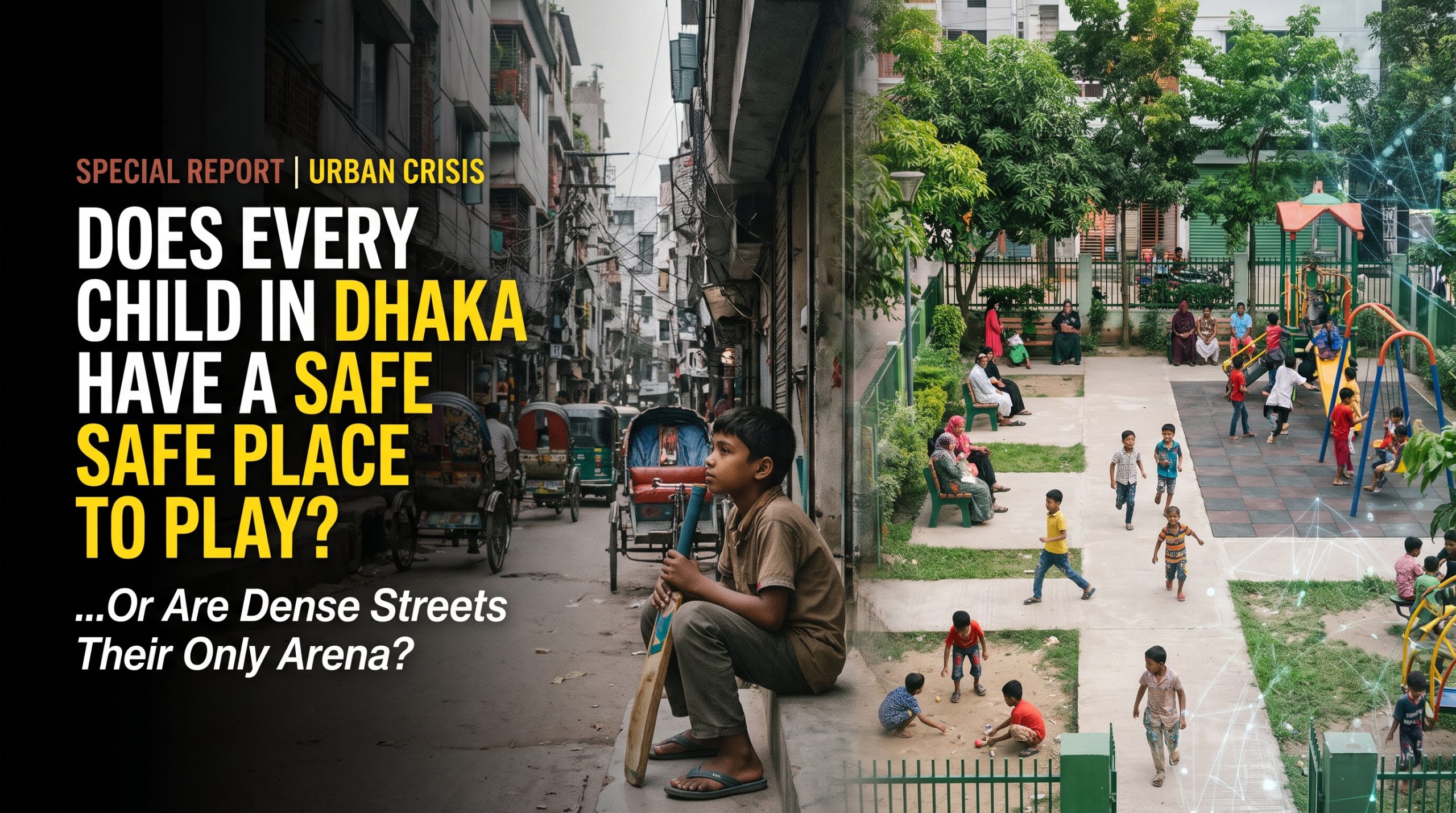
The act of playing is significant to children’s lives. It gives children opportunities to exercise, make friends, learn about creativity and problem-solving. However, opportunities for play in places where it is safe and accessible are increasingly scarce in dense urban areas like Dhaka.
In 2026, Development Policy Centre published an article, where it is reported that only 0.9% of Dhaka’s land are open spaces. It also finds that 36% of children in a study of 403 children aged 8-18 in selected neighbourhoods – both planned and unplanned – indicated that they had a park within a 10-15 minute walking distance from home. The results indicate that there is a critical issue in urban areas: kids require opportunities to play, and where they reside, they might not be able to.
Playgrounds are not just for recreation. Children benefit from physical activity in supporting health and also benefit from playing with others in their ability to communicate, co-operate and problem solve. Children may spend more time indoors or in front of a screen if they can’t access safe outdoor areas. Children that play in busy streets or other unsafe areas may also be at risk of traffic injury.
This disproportionately impacts children who live in neighbourhoods with scarce public facilities, large population densities and in low-income unplanned settlements, where there is little land available. Where parks are unsafe or social expectations limit girls’ outdoor activity, there are further barriers to overcome. Play areas also can be a barrier to children with disabilities because of the lack of accessible entrances, appropriate play equipment and safe pathways. Younger children require age-appropriate spaces and older children and teens require places for sports, exercise and social interaction.
The Dhaka study shows that distance is not the only factor when it comes to access to parks. Safety and accessibility, and public space quality, also play a role. Children may have access to a park but not be able to use it due to traffic, lack of lighting, lack of equipment or limitations on play. Sustainable Development Goal 11 promotes green and public spaces for all, including children, older people and persons with disabilities, inclusive, safe and accessible. Children’s daily needs should be taken into account in urban planning instead of viewing playgrounds as optional.
Rapid urbanisation, high population density and competing demands for land are the reasons. Space is required for homes, transportation, commercial and other facilities. If urbanizing activities do not make room for recreation, there is a risk that playgrounds could be neglected. Even if there’s a park there, it may not be well maintained, lit or have equipment, toilets and drinking water for people with disabilities. A lack of public funding and not consulting with children and families can exacerbate the issue.
As opportunities for play continue to diminish children may not have opportunities to engage in physical activity, friendship and independent exploration through safe play spaces. They might be exposed to traffic and other risks from unsafe alternatives. Differences over time may result in disparities between children living in well-planned neighbourhoods and children living in crowded neighbourhoods with respect to recreational facilities.
City officials need to preserve existing playgrounds, and develop new public spaces and enhance safety and access to parks. Children’s needs should be taken into consideration during the initial stages of urban planning, including for younger children and children with disabilities, and especially for girls. For schools and communities with restrictions on available space, it is worth looking at smaller safe play spaces in appropriate unused space. School corridors and other suitable surfaces can be modified to accommodate active games provided there are no issues with safety, access or supervision.
An example is Reflective Teens’ Classroom Sidewalk Game Project, a project involving colourful games and markings to provide play opportunities in school spaces. It has a replication status of over 25 schools and more than 50,000 students in its HundrED innovation profile. These are reported on by the innovation profile and not independently verified impact figures. These methods can be used alongside, but in no way substitute for the provision of permanent, public and accessible playgrounds.
Children had the right to rest, recreation and play. Dhaka is constantly expanding and preserving space for children needs to be incorporated into responsible urban development. It is important that governments, schools, communities and planners collaborate to ensure that every child has a safe place to play, irrespective of their location and family income.
References:
Azad, R., Rahman, S., & Uddin, G. (2026, September 7). Safe, playable and accessible? Children’s marginalisation from city spaces. Development Policy Centre, https://devpolicy.org/safe-playable-and-accessible-childrens-exclusion-from-urban-public-spaces-20260907/
United Nations. (n.d.). Goal 11: Sustainable cities and communities. www.sdgs.un.org/goal11
HundrED. (2023). Sidewalk Game Project in the classroom.
https://hundred.org/en/innovations/classroom-sidewalk-game-project
